Archive for the ‘HCM Dashboard’ Category

Filed Under (HCM Dashboard, Org Modeling, Succession Planning, Talent Management, Visualization) by admin on August-30-2010

It was interesting to read the feedback on the Extend Technologies blog after a preview of Visualization Solutions by Nakisa 3.0. It’s very encouraging to read such positive feedback – so thanks for the shout out! If you have had a preview of the latest Nakisa solution, we’d love to hear your thoughts.

If you have not seen 3.0 yet and would like a preview, you can request a demo in the Nakisa VIP Zone.


Filed Under (HCM Dashboard, Talent Management) by admin on February-16-2010

In an effort to support more sustainable practices in business, organizations are examining the value of diversity in the workforce. Besides regulatory compliance, what benefits make having a ‘diverse workforce’ good for business?


Some key outcomes of maintaining a diverse workforce (i.e. age, gender, ethnicity, religion, skill set) include the ability to:


• Enable innovation and creative thinking by bringing together fresh ideas voiced from differing points of view

• Improve your capacity to understand and serve your different customers, partners and shareholders by representing their diversity in house

• Better support market expansion by region, culture and demographic

• Encourage talent acquisition and retention

• Foster organizational adaptability by maintaining a well-rounded pool of varied skills


SAP, the highest-ranked software company in the 2009 Dow Jones Sustainability Index for two years running, has an interesting perspective on the business value of diversity in the workforce. 


To learn more about how a diverse workforce can help you achieve sustainable business performance, I encourage you to visit SAP’s Sustainability Map (and check out the Sustainable Workforce / Diversity field).


Filed Under (HCM Dashboard, Org Modeling, Succession Planning, Talent Management, Visualization) by admin on January-29-2010

With the release of version 2.1 of SAP Talent Visualization by Nakisa (SAP TVN), I wanted to highlight a few of the new innovations I’m particularly excited about.

SAP TVN was originally developed to empower users with clarity into their organization and talent with interfaces that visualize core HCM data. Each subsequent release of the solution has incorporated the latest technology and best practices in data visualization, so customers are always getting the most value out of their underlying HCM information. The enhancements with 2.1 are no exception.

We’ve worked to reduce the number of clicks it takes to visualize the right information and take the proper action. Part of this is thanks to the integration of new interactive Flash-powered tools such as our new Talent Grid (9-box) which supports drag-and-drop functionality enabling instant talent calibration on the spot.

We’ve also launched Profile Match for 2.1, an innovative decision support tool for succession planning. Users can quickly and objectively find the right successors for any given role. The Profile Match mechanism uses organizational competencies and qualifications to bring successors and positions together in a way that promotes alignment between global objectives and the talent pipeline.

The new Java Edition will offer our customers many benefits, mainly lowering their total cost of ownership. In addition to running on a .Net platform, organizations are now able to run SAP TVN on the Java platform, eliminating the need to purchase additional Windows servers

I am very excited about these enhancements and I invite you to sign up for a personal demonstration of our solutions in Nakisa’s VIP Zone.


Filed Under (HCM Dashboard, Rightsizing, Succession Planning, Talent Management, Visualization) by admin on January-15-2010

Talent Management Magazine recently highlighted the benefits of adopting sustainable activities within the organization. The feature story highlights how businesses who commit to “green” practices are more likely to attract and retain the best talent, realize savings, and improve their image.  As is common practice these days, the article uses the term “sustainability” to refer to environmental and social responsibility. No doubt, an organization’s responsibility to the planet is very important; however when it comes to defining the key link between “talent management” and “sustainable business,” a key perspective is often overlooked: building a workforce to ensure success that lasts.


Your organization may have all the best intentions to save the planet today, but if it can’t endure competitive, technical, social and economic turbulence in the long run, it won’t be around tomorrow when the planet still needs saving. With effective talent management processes and tools, an organization can devise and maintain a talent pipeline strategy to keep them successful well into the future. A truly sustainable workforce should ensure that the enterprise always maintains the critical competencies that enable efficiency, innovation and agility despite the changes in external forces.


For more information about creating a Sustainable Workforce, I recommend you check out SAPs EcoHub Sustainability Map.


Filed Under (Data Cleansing, HCM Dashboard, Succession Planning, Talent Management) by admin on December-16-2009

Across all levels of your enterprise, people are being bombarded with information. Just consider the last time you researched a hot topic on the Internet; the number of search engine results can easily come back in the tens of millions! The solution to this “information overload” is to find ways to deliver the most relevant information in the shortest amount of time.

In order to keep up with demand, our VIP Section has now been transformed into the VIP Zone. Information is now easier to find; you can now browse through our informational resources based on which Nakisa solution you’re interested in, which challenges your business is facing, or your specific industry. The VIP Zone also offers you the chance to workshop your talent management initiatives with Nakisa representatives and value engineers. I am especially confident in the ROI exercise that we can arrange for you at no cost.
The goal of our software at Nakisa is to get the right information to the right person at the right time. This philosophy is now mirrored in the way we have organized our VIP Zone.
Sign up for an account today so you can learn how Nakisa can help you align your talent with your strategic initiatives.


Filed Under (HCM Dashboard) by admin on June-19-2008

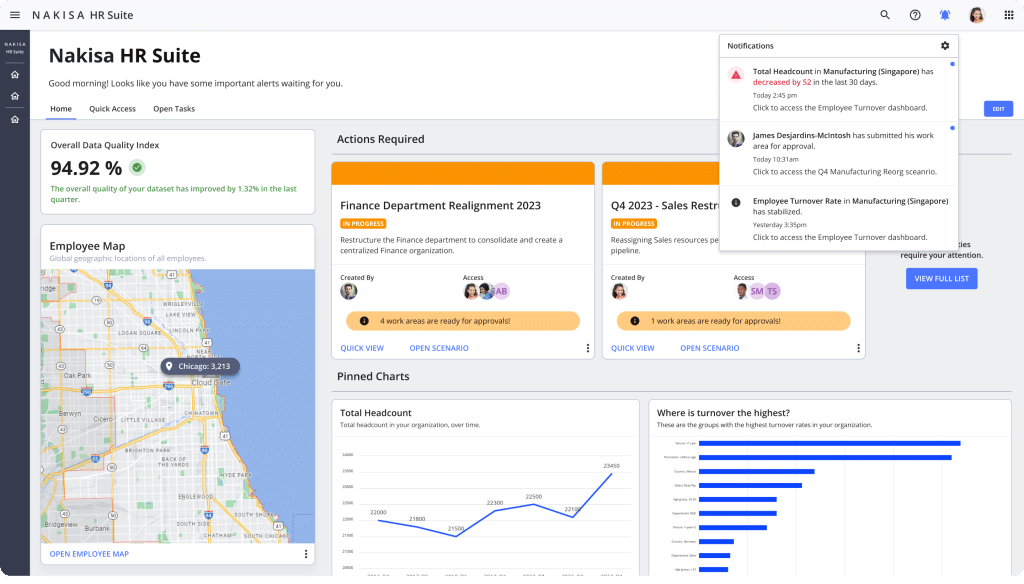
Part of developing an effective succession planning strategy involves measuring and monitoring the progress of succession management initiatives. One of the best ways to do so is with a dashboard.  Dashboards provide talent “indicators” that provide you with the intelligence required to prioritize action items and make decisions.  To provide the most value, dashboards must have both visual indicators, such as which high potential employees are also flight risks as well as be able to display relevant metrics associated with talent objectives including:


  • Headcounts
  • # of Vacant Positions
  • Turnover
  • Time to Fill Key Positions
  • Cost per Hire
  • Retiring Employees


How do Dashboards Help with Succession Planning?

  1. Measure and Monitor Succession Plans:  Where our organization’s succession plans are today and where we need to be in the future. If I am planning a global expansion in 10 countries by 2010, do I have the resources required to fill those key positions in local areas?
  2. Simple, personalized views: Dashboards can be tailored to a user’s specific needs, based on their role in the organization i.e. HR vs. Execs. vs. Managers vs. regular employees.
  3. Real time data: Having a real-time view of your talent and succession plans is essential.  With real-time, actionable talent information, organizations can take corrective measures and positively impact business outcomes.
  4. Identify high priorities: Specific indicators can help you to be alerted to information that is relevant to you, so you can prioritize accordingly and take action.

Organizations can visualize problem areas with dashboards; however, alone they do not provide enough information. It is important for organizations to use dashboards to also gauge the meaning of the measurement and allow the ability to drill down further to fully understand underlying factors.  For example, simply showing a high turnover rate for key positions is important, but it is also important to indicate to the user why this is occurring.   


As business objectives and succession planning strategies change, dashboards must evolve to ensure relevant talent metrics and key performance indicators (KPIs) are being measured.  Through quick access to real-time, actionable talent information, organizations can effectively measure, monitor and execute their succession planning strategies.