Filed Under (HCM Dashboard, Org Modeling, Succession Planning, Talent Management, Visualization) by admin on August-30-2010

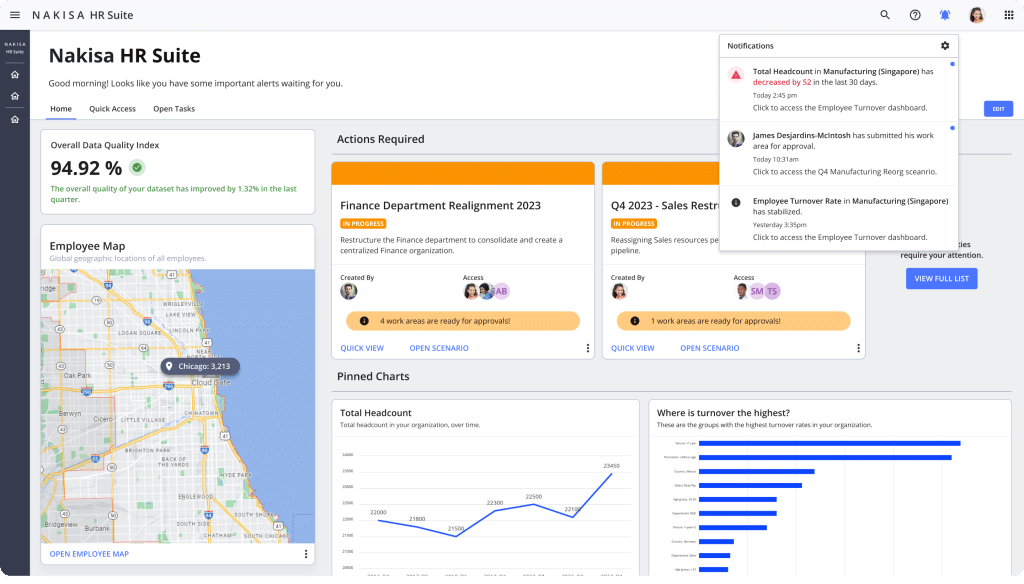
It was interesting to read the feedback on the Extend Technologies blog after a preview of Visualization Solutions by Nakisa 3.0. It’s very encouraging to read such positive feedback – so thanks for the shout out! If you have had a preview of the latest Nakisa solution, we’d love to hear your thoughts.

If you have not seen 3.0 yet and would like a preview, you can request a demo in the Nakisa VIP Zone.


Post a comment
Name: 
Email: 
URL: 
Comments: 
Filed Under (Org Modeling, Talent Management, Visualization) by admin on August-24-2010

Organizational agility is a hot topic in the industry right now. In current market conditions, organizations must learn to respond quickly to change. Large enterprises find this particularly difficult as they continually have to assess current business challenges and align their human capital strategy accordingly. In the article “The Agile Organization,” (Talent Management Magazine, July 2010 issue), the authors discuss the importance of a “nimble” human capital strategy and an adaptive workforce. Speed and adaptability is crucial to using talent to make organizations successfully manage changing scenarios.

So, how do we provide large enterprises with tools that can make the process faster and enable them to be more adaptable to their current environment?
At Nakisa, we specialize in providing solutions and support to organizations for this exact challenge. Nakisa OrgModeler enables users to create “what if” scenarios, providing a clear view of how organizational changes will affect headcount, budget, reporting structures, and so on.

OrgModeler also allows the user to save scenarios, and share them with their peers for review and modification. By visualizing potential scenarios, and achieving buy-in from key stakeholders, an organization can quickly determine the correct business strategy, and execute efficiently. With effective talent management visualization tools, the challenge of achieving organizational agility is much easier.


Post a comment
Name: 
Email: 
URL: 
Comments: 
Filed Under (Nakisa's Partner Ecosystem) by admin on May-21-2010

The consistent feedback from customers, partners and analysts was that SAPPHIRE® NOW was a great event and I couldn’t agree more. Folks like Thomases Otter, and Wailgum, Ray Wang and Dan Howlett did a great job outlining the details from the show floor, so I wanted to focus on my takeaways from this year’s show.

First, SAP has probably taken one of its most courageous leaps in recent history with their “On-Premise, On-Demand and On-Device” initiative. Some have slated them as being late for the party and said the acquisition of a 2nd tier DB company makes no sense. On the contrary I think Bill, Jim, Hasso and Vishal showed that this acquisition makes a lot of sense when you also consider SAP’s existing investments in in-memory DBs, mobile and a Cloud platform + applications

Next, one point that has received less attention is how this acquisition will open up even more opportunities for SAP’s already vibrant partner ecosystem. As a long-time member of this very unique club, we have already been given the opportunity to take part in many programs (some official and some not ☺) around helping SAP innovate. The TalentOnDemand application built on SAP’s cloud platform we showcased at SapphireNow is yet another example of this.

Finally, it was great to see that SAP is back on track with a renewed focus on its customers. Bill is the right guy to lead the charge as he has consistently focused on customers while climbing the C-ladder at SAP.

Nakisa has always strived to make our customers champions and I think this was clear both in Orlando and Frankfurt seminars which are still available for you to watch via SAPPHIRE Online. It’s always an honor when our customers share their Nakisa experience with others.

Although SAPPHIRE may be over, I feel this is really a great beginning. Don’t forget to register for our upcoming webinar with Kohler on June 2nd and until next time, don’t forget to Visualize What Matters Most™


Post a comment
Name: 
Email: 
URL: 
Comments: 
Filed Under (Talent Management) by admin on May-3-2010

With Earth Day having passed just recently, I found it quite fitting that the latest volume of SAPInsider had an article entitled “Ensure That Your Company’s Talent Pool Never Runs Dry”.

The writer of this article, Bil Khan of SAP, outlines the basis of building a sustainable workforce. Business success in the future will rely on the ability to visualize key organizational information, and act upon it in order to align talent with business strategies.

As we continue to look towards the future, I urge business leaders not to forget about their most important resource – their people.

Until next time, remember to Visualize What Matters Most™


Post a comment
Name: 
Email: 
URL: 
Comments: 

A recent blog by George Anders of the Harvard Business Review discussed the take-home lessons of a recent talent management conference. Although industries are moving beyond the economic downturn, it is clear to many major organizations that they have yet to “get talent management right.” For example,  attendees mentioned issues with developing an effective internal talent pipeline. Imagine how difficult it would be if your organization does not even have the right people to put in the right place. It would be extremely difficult to optimize talent deployment in this setting- as was discussed in a previous blog.

The most striking statistic from Anders’ post is that 72% of companies consider the war for talent as “an endless struggle in which they are neither gaining nor losing ground.” It is therefore necessary to start thinking of solutions to this challenge.

After having read the blog, I was happy to see the following comment posted by a reader:

“Companies who want to win the very real war for talent need to radically change the way they build talent. They need to make talent practices simpler (so that managers will actually use them) and more transparent (to avoid the negative impacts of secrecy), and enforce managerial accountability (since building great talent is their highest responsibility!)”

I couldn’t agree more. Simplicity, transparency, and increased accountability will be essential for organizations seeking to win ground in the war for talent.

As an aside, I would like to announce to all the readers of this blog that Nakisa has been nominated for an SAP Pinnacle Award in the category of Global Software Solution of the Year. Thank you to all of those who have supported us in the past year and, until next time, remember to Visualize What Matters Most™


Post a comment
Name: 
Email: 
URL: 
Comments: 
Filed Under (Nakisa's Partner Ecosystem, Succession Planning) by admin on April-5-2010

It’s late into the night, and an entire stadium of energetic fans falls silent. Both teams have made it through regulation and extended play but are still tied for points. The entire game comes down to a moment of truth—the shootout.

Many different types of competitions have a standardized method when it comes to selecting the best team, the best athlete, and sometimes the best candidate.

The question I pose to readers this week is, “What happens when you are encountered with two seemingly equal candidates to fill a key position in the organization?” Some individuals rely on a list of “pros” and “cons” of either candidate, but this may be based on arbitrary preferences. Others may be willing to “go with their gut” and rely purely on instincts to decide which candidate is best suited for a position. But when it comes to the critical roles that are essential to the proper functioning of your business, the “moment of truth” needs an objective and consistent decision support system.

It is for this reason that the latest release of SAP® Talent Visualization by Nakisa® features tools such as the enhanced succession calibration grid to help you clearly identify the right person for a role. The solution also features our unique profile match capability. Nakisa’s profile match provides a flash based interface to track down and compare, side-by-side, potential succession candidates based on the role requirements. If the showdown is still “too close to call” our profile match also displays non-shared competencies that may not be required for the position, but may prove to be a valuable asset, putting the winner over the top.

Click here to find out what our Global Service Partner, ROC, has to say about it our latest release.

Until next time, remember to Visualize what Matters Most™


Post a comment
Name: 
Email: 
URL: 
Comments: 
Filed Under (Nakisa's Partner Ecosystem, Succession Planning) by admin on March-29-2010

My team and I were very excited to attend SAP HR 2010 last week in Orlando. Each year, SAP HR proves to be a great event for us as we connect with the right people in the SAP/HR arena. However, this year was especially interesting for us as Nakisa was featured in over ten sessions throughout the event (the majority of which were volunteered by customers and partners without our solicitation). Each day in Orlando, our booth was constantly visited by individuals saying things like ‘I just came from a talk that highlighted Nakisa. How can I learn more?”.  As the attendees met with us, they were very interested in the demos of our latest release and our video presentations on Advanced Competency Management. It was great to touch base with the different conference participants and to demonstrate our commitment to providing innovative solutions in talent visualization and management.

I invite you all to get to know us better through our videos, and by following our posts on Twitter. For those of you who were unable to attend SAP HR in Orlando, we have posted some information on the seminars in our VIP Zone.

Until next time, remember to Visualize What Matters Most™.


1 Comment posted on "Nakisa: All the Buzz in Orlando!"
robes on March 30th, 2010 at 2:27 pm #

awesome news.

robes

Post a comment
Name: 
Email: 
URL: 
Comments: 
Filed Under (Succession Planning, Talent Management, Visualization) by admin on March-16-2010

I’m sure you’re all familiar with the show You’ve Got Talent where budding entertainers seek to win a contest by unveiling their hidden talents before a panel of judges. Contestants have to pass through several auditions before a winner is chosen. This process reminds me a lot of how some organizations recruit talent from within. The HR department posts a job and prospective employees “audition” in hopes of winning the “talent contest”. This process is reactive rather than proactive.

With a talent visualization system in place, organizations can clearly see and then map employees’ skills to job openings without undergoing a time-consuming series of interviews in order to “discover” the right candidate. Organizations owe it to themselves to adopt a talent management system so as to visualize the “hidden” talent in their midst.

Until next time, remember to Visualize What Matters MostTM.


Post a comment
Name: 
Email: 
URL: 
Comments: 
Filed Under (Succession Planning, Talent Management, Visualization) by admin on March-5-2010

I came across an article called Optimizing Talent as Organizations Flatten in the latest issue of Talent Management.  In mapping out the ‘Talent Life Cycle Model’ the article illustrates how the productivity of a role drastically drops with a sudden vacancy. This drop in ‘employee contribution’ is due to ramp-up time of the new hire.  Building on the ‘Talent Life Cycle Model’, it makes sense that effective succession planning can help avoid the downtime associated with a new hire, by enabling succession ‘bench’ employees to ‘ramp up’ in advance.  However, an obstacle to effective succession planning is the lack of connectivity with the other talent management activities (employee reviews, development, career planning etc.).

Best practice organizations understand that organizational competencies are the critical building blocks that connect talent management activities. With competencies used as the standard for measuring both human capital and roles, organizations can clearly identify talent gaps and match the best-fitting employees to fill those gaps. By enabling in-house mobility and bypassing ramp up involved with hiring and training new talent, talent deployment is then optimized to maximize employee contributions sooner rather than later.

Nakisa has produced a video that further discusses the benefits of advanced competency management. I encourage you to check it out on YouTube:

Advanced Competency Management

Until next time, remember to Visualize What Matters Most™


1 Comment posted on "Optimizing Talent Deployment with Competency-based Succession Planning"

[...] A recent blog by George Anders of the Harvard Business Review discussed the take-home lessons of a recent talent management conference. Although industries are moving beyond the economic downturn, it is clear to many major organizations that they have yet to “get talent management right.” Attendees mentioned issues with developing an effective internal talent pipeline. After all, if your organization does not even have the right people to put in the right place, it will be impossible to optimize talent deployment, as was discussed in a previous blog. [...]

Post a comment
Name: 
Email: 
URL: 
Comments: 
Filed Under (Org Modeling, Rightsizing) by admin on February-26-2010

Although the pace of M&A activity has slowed since the recent financial downturn, pundits predict that it will accelerate in 2010. So it was interesting that I came across this article that discussed why so many attempts to merge companies are ultimately unsuccessful.

The article lists 3 main reasons why M&As fail:

1. Executives don’t understand the important link between business processes and systems;

2. Business leaders cannot agree on a framework for achieving commonality among the misaligned processes and systems;

3.  Finally, the inability of important decision makers to make difficult but necessary business decisions.

All of these reasons fall under the category of organizational management. However, I would suggest a fourth reason to help explain the lack of success with M&A’s, which falls under the category of talent management:

4. Failure to effectively merge the workforce and optimize the new talent pool.

Without having the right people in the right positions at the right time, a company merger can still fail even when executives have seemingly “dotted their i’s and crossed their t’s”. To avoid overlooking potential workforce pitfalls, clear visibility of talent is critical throughout the entire merger process.


Nakisa has produced a video that speaks to that visibility. I encourage you to check it out on YouTube:

The Case of the Mixed-Up Merger

Until next time, don’t forget to Visualize What Matters MostTM


Post a comment
Name: 
Email: 
URL: 
Comments: